This post may contain affiliate links. If you click and buy, we may earn a small commission at no extra cost to you. Learn more.
Hallways are often the most overlooked spaces in a home. Too narrow for furniture, too utilitarian for decoration—or so the thinking goes. But when wood shelving is introduced thoughtfully, a hallway transforms from passage to place.
The shelving doesn’t need to be elaborate. A single floating shelf in oak can anchor a narrow entryway. A floor-to-ceiling bookcase in walnut can turn a wide hallway into a working library. The wood itself—its tone, grain, finish—does much of the work.
What makes these spaces succeed is restraint. The shelving serves a function, but it also establishes mood. It holds keys and mail, yes, but also books, plants, pottery. The hallway becomes a gallery of daily life rather than a corridor to pass through quickly.
The ideas here range from minimal to maximal, narrow to expansive. They’re meant to show how wood shelving adapts to different hallway proportions and household needs without sacrificing visual calm.
Contents
- 1 What you’ll find here:
- 2 1. Floor-to-Ceiling Oak Shelving in a Wide Hallway
- 3 2. Single Floating Walnut Shelf Above Console Table
- 4 3. Reclaimed Wood Ladder Shelf Against Exposed Brick
- 5 4. Built-In Cubby Storage in Pine
- 6 5. Narrow Floating Shelves in Light Ash
- 7 6. Corner Shelving in Dark Walnut
- 8 7. Open Bookcase Dividing Hallway from Living Area
- 9 8. Slim Console with Upper Wall-Mounted Shelving
- 10 9. Rustic Beam Shelving with Iron Brackets
- 11 10. Minimalist Ledge Shelves in Pale Maple
- 12 11. Full-Wall Hallway Library in Cherry
- 13 12. Asymmetric Modular Shelving in Birch
- 14 13. Shallow Niche Shelving Built Into Wall
- 15 14. Industrial Pipe and Wood Plank Shelving
- 16 15. Narrow Hallway with Staggered Box Shelves
- 17 Styling Tips to Pull the Look Together
- 18 Conclusion
What you’ll find here:
- Distinct hallway concepts rooted in real homes
- Inspiration you can adapt gradually
- Complete looks, not isolated details
- Ideas that suit different hallway sizes and styles
1. Floor-to-Ceiling Oak Shelving in a Wide Hallway
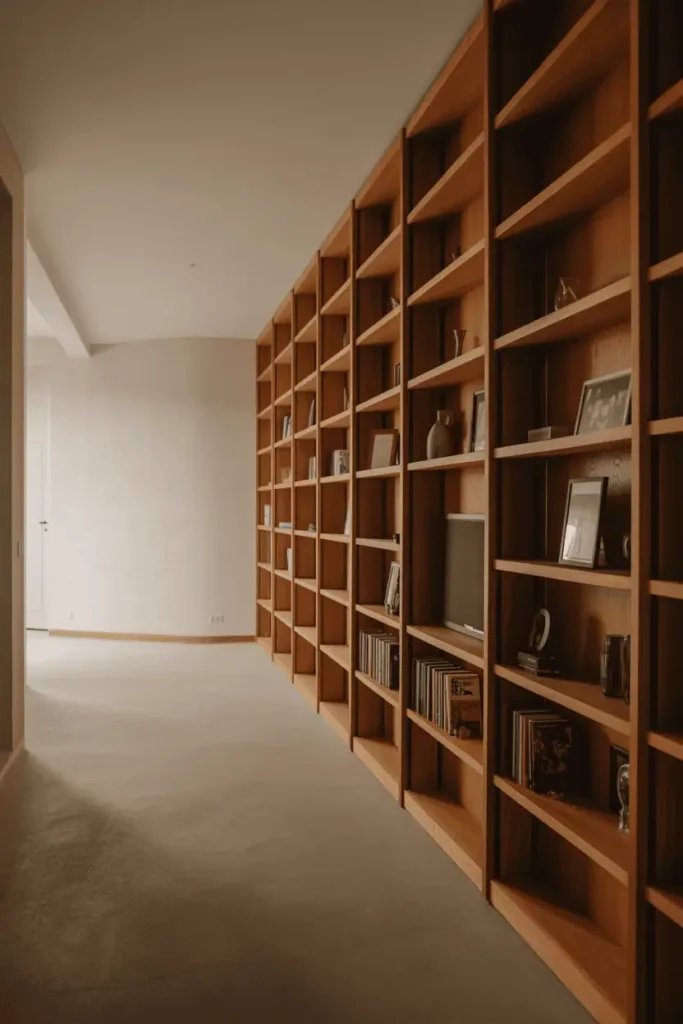
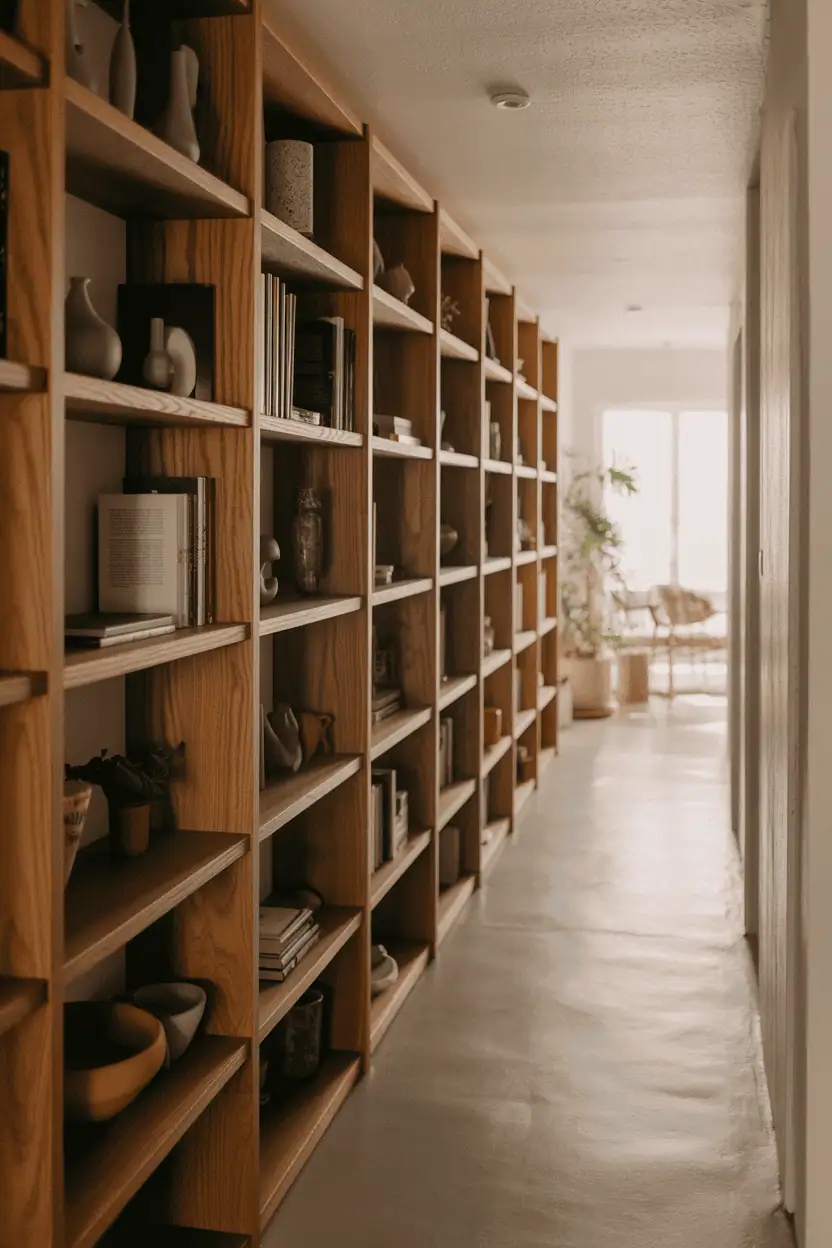
The hallway is wide enough to accommodate a full wall of built-in oak shelving without impeding flow. The shelves run from floor to ceiling on one side, with varied depths—some deep enough for books, others shallow for framed photos and small objects. The wood is finished in natural oil, showing the grain clearly. The opposite wall is white plaster, and the floor is polished concrete.
This works best in homes with generous hallway width, where the shelving becomes the hallway’s purpose rather than an afterthought. The oak adds warmth to what could otherwise feel like a utilitarian space. The varied shelf depths create visual rhythm.
Design note: Keep the styling restrained—books interspersed with open space, not packed tight.
2. Single Floating Walnut Shelf Above Console Table
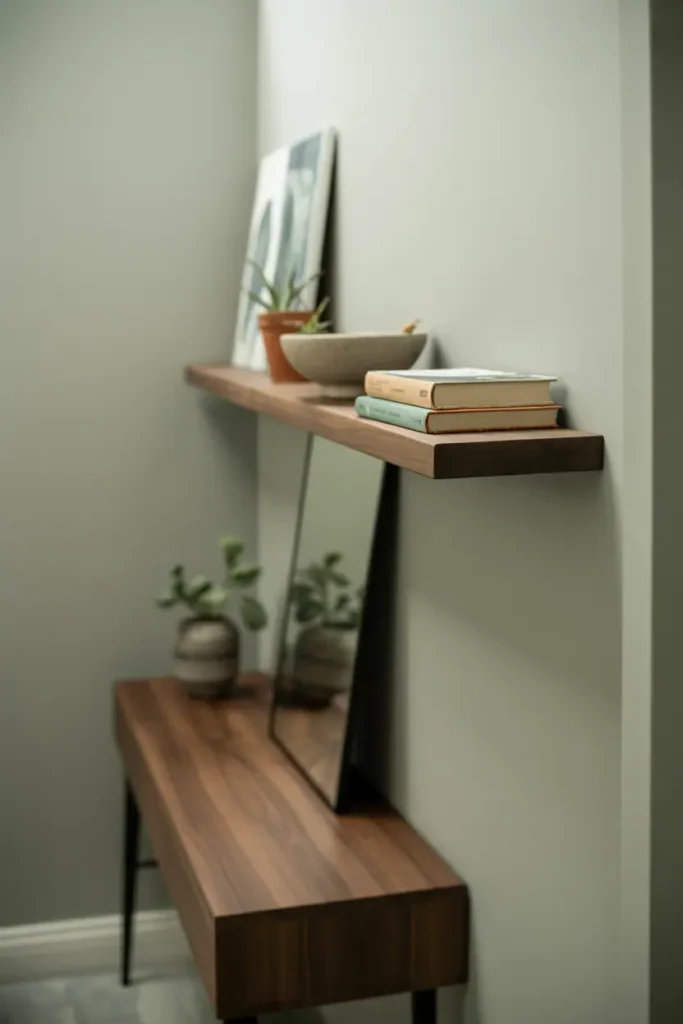
A narrow hallway with limited wall space. A single floating walnut shelf—12 inches deep, 6 feet long—is mounted at eye level above a slim console table. The shelf holds a few carefully chosen objects: a ceramic bowl, a small plant, a stack of three books. The console below is also walnut. The walls are soft gray, and a mirror leans against the wall on the console.
The single shelf provides function without clutter. It defines the entry moment without overwhelming the narrow proportions. This suits small apartments or homes where the hallway is truly a transition space with minimal width.
3. Reclaimed Wood Ladder Shelf Against Exposed Brick
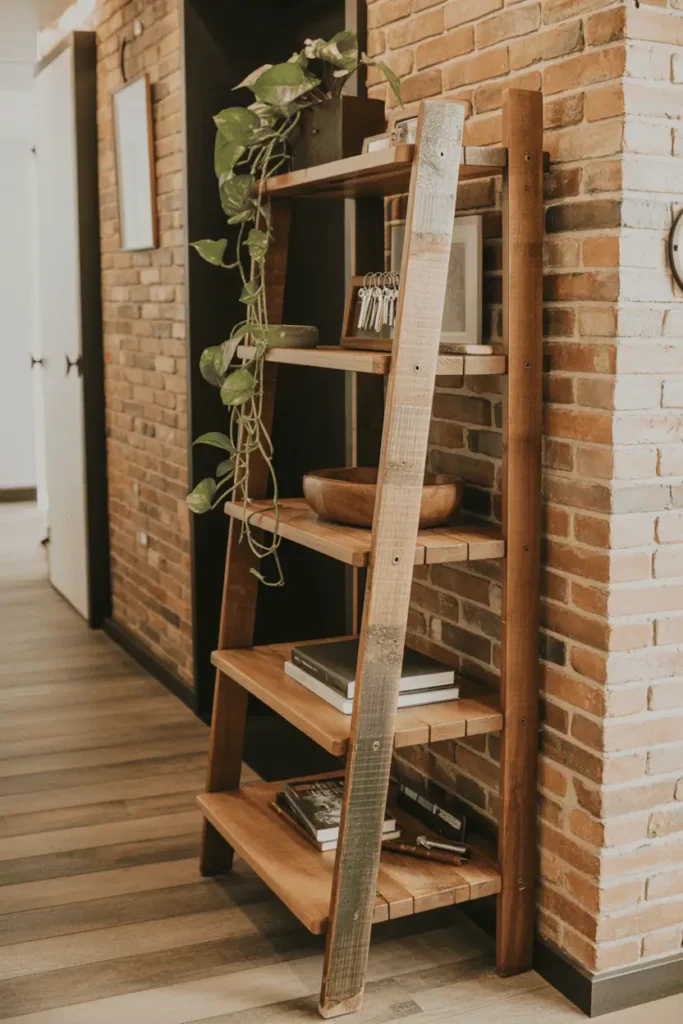
The hallway walls are exposed brick, original or intentionally left bare. A reclaimed wood ladder shelf leans against the brick—five tiers of shelving with a natural patina and visible age. Each shelf holds a mix of practical and decorative items: keys in a wooden bowl on the bottom shelf, books on the middle shelves, a trailing pothos on top. The floor is worn wood planks.
This approach adds character through material contrast. The reclaimed wood and brick create a layered history. It works in older homes, lofts, or renovated spaces where industrial-meets-rustic feels natural.
4. Built-In Cubby Storage in Pine
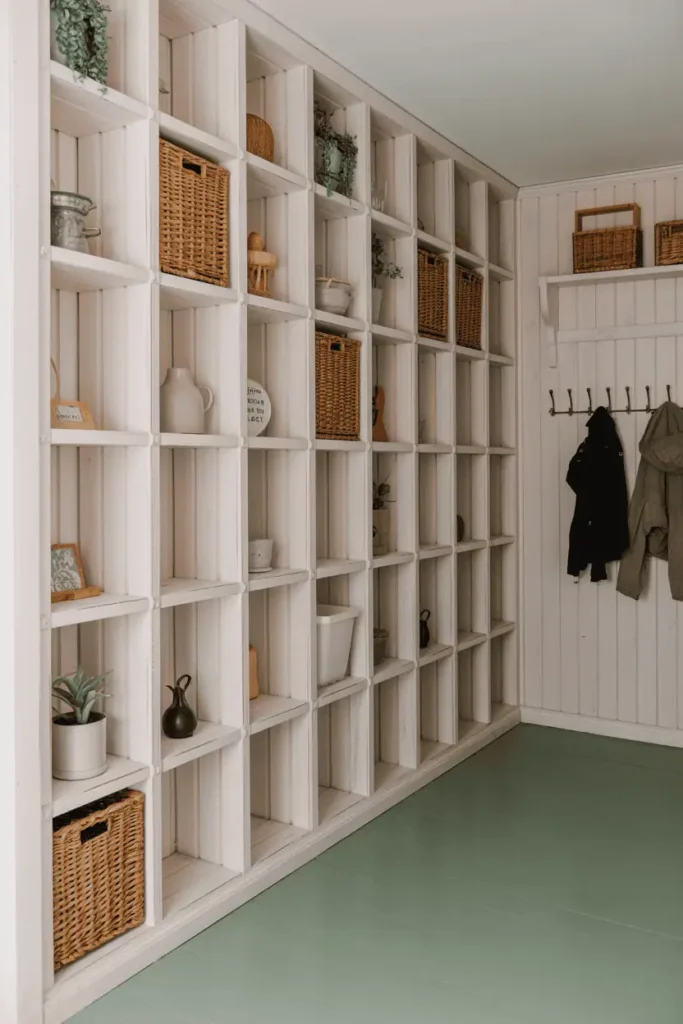
A short, wide hallway leading to bedrooms. The entire right wall is covered in built-in cubby storage constructed from pine—a grid of square openings, each about 12 inches per side. Some cubbies hold baskets for hats and gloves, others display pottery or small plants. The pine is whitewashed. The left wall has hooks for coats. The floor is painted wood in soft sage.
The cubby system keeps the hallway functional for a family while maintaining visual order. The whitewashed pine keeps it light. This works best in homes with kids or where daily-use items need accessible storage.
5. Narrow Floating Shelves in Light Ash
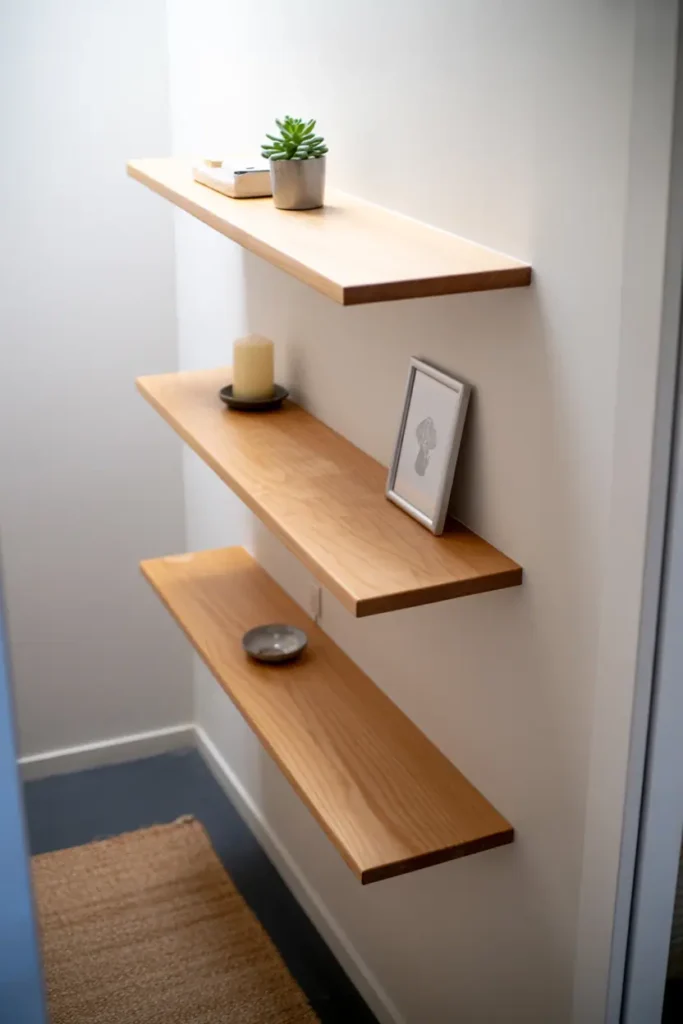
An extremely narrow hallway—maybe 3 feet wide. Three thin floating shelves in light ash are staggered along one wall at different heights. Each shelf is only 6 inches deep. They hold minimal objects: a small succulent, a candle, a single framed print. The walls are white, and a runner rug in natural fiber runs the length of the floor.
When width is severely limited, shallow shelves provide visual interest without encroaching on walking space. The staggered heights create a sense of movement. This suits long, narrow hallways in apartments or older homes.
At this point, the hallways begin to show how wood shelving adapts to constraint. The material stays constant, but the scale and approach shift with proportion.
6. Corner Shelving in Dark Walnut
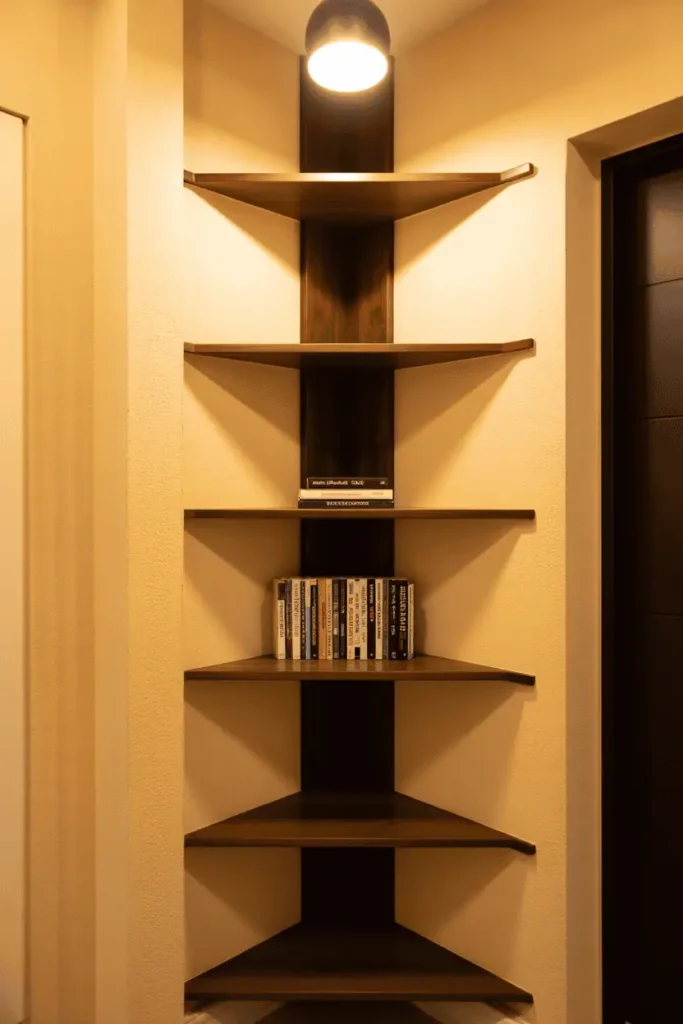
The hallway makes a 90-degree turn, creating an awkward corner. Custom corner shelving in dark walnut wraps around the angle—five triangular shelves stacked vertically, each secured to both walls. The shelves hold a rotating display of books and objects. The walls are painted a warm cream, and pendant lighting highlights the corner.
Corner shelving turns a spatial challenge into a focal point. The dark walnut contrasts with lighter walls and draws the eye. This works in hallways with turns where dead space can be activated.
7. Open Bookcase Dividing Hallway from Living Area
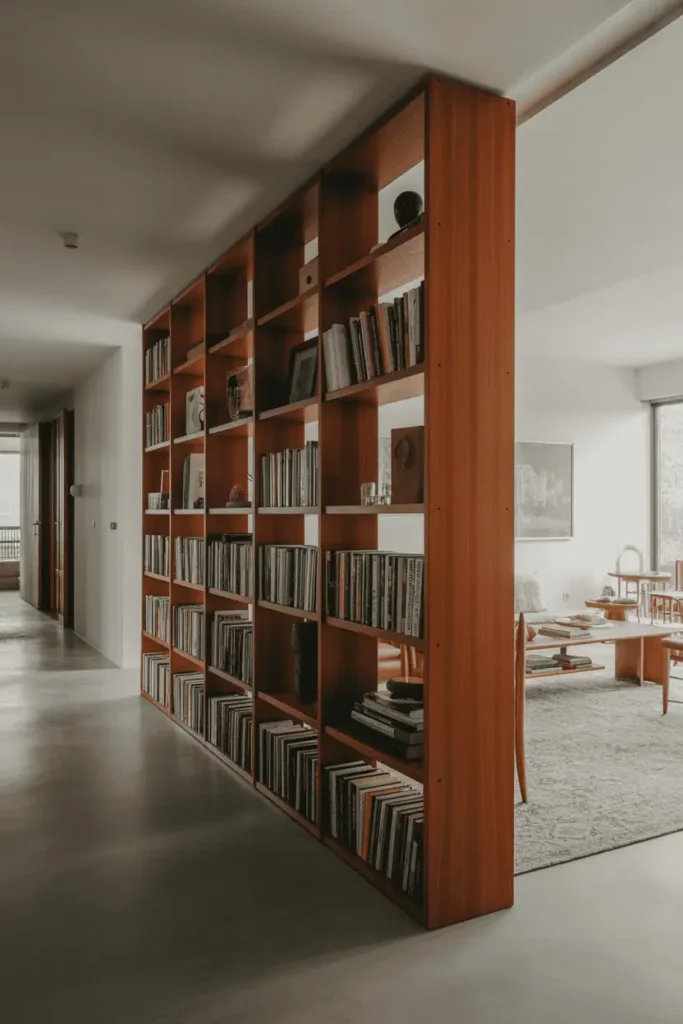
An open-plan home where the hallway flows into the living room. A freestanding open bookcase in teak—double-sided, floor-to-ceiling—acts as a visual divider. Books and objects can be accessed from both sides. The bookcase provides separation without closing off space. The floor on both sides is polished concrete.
This approach works when you want distinction between zones without adding walls. The teak adds warmth and weight. It suits contemporary homes with open layouts where traditional boundaries don’t exist.
8. Slim Console with Upper Wall-Mounted Shelving
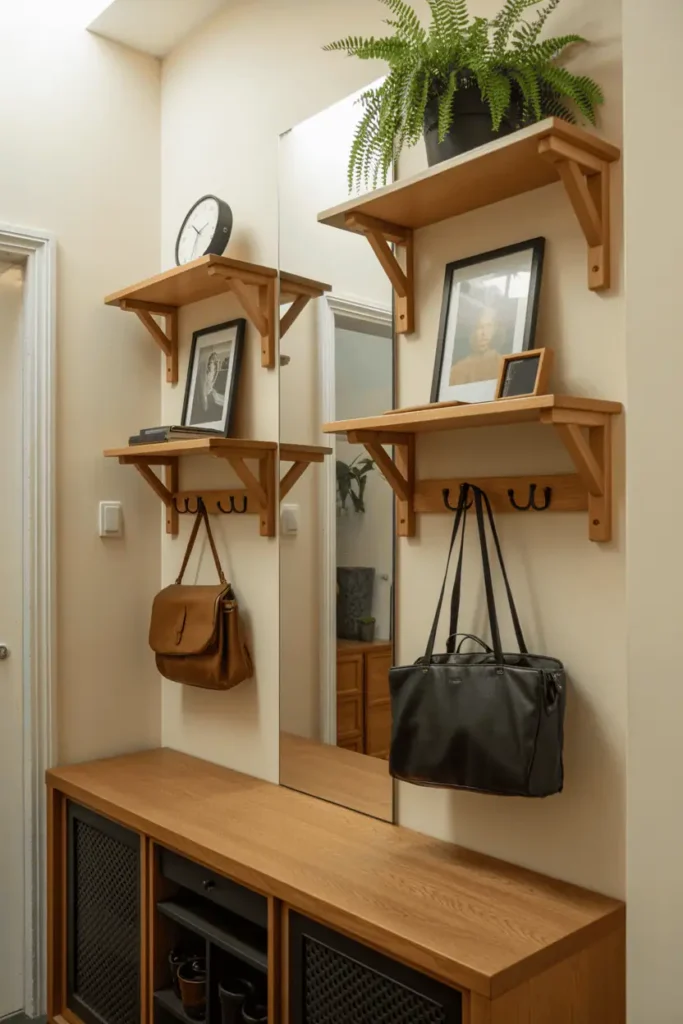
A medium-width hallway. A slim console table in oak sits against one wall—no more than 10 inches deep. Above it, three wall-mounted shelves in matching oak create a vertical display area. The shelves hold framed family photos, a small clock, a potted fern. Hooks are mounted below the console for bags. The opposite wall is bare except for a large mirror.
The combination of console and upper shelving maximizes vertical space in a medium hallway. The matching wood creates cohesion. This works for entryways where you need both display and drop-zone functionality.
9. Rustic Beam Shelving with Iron Brackets
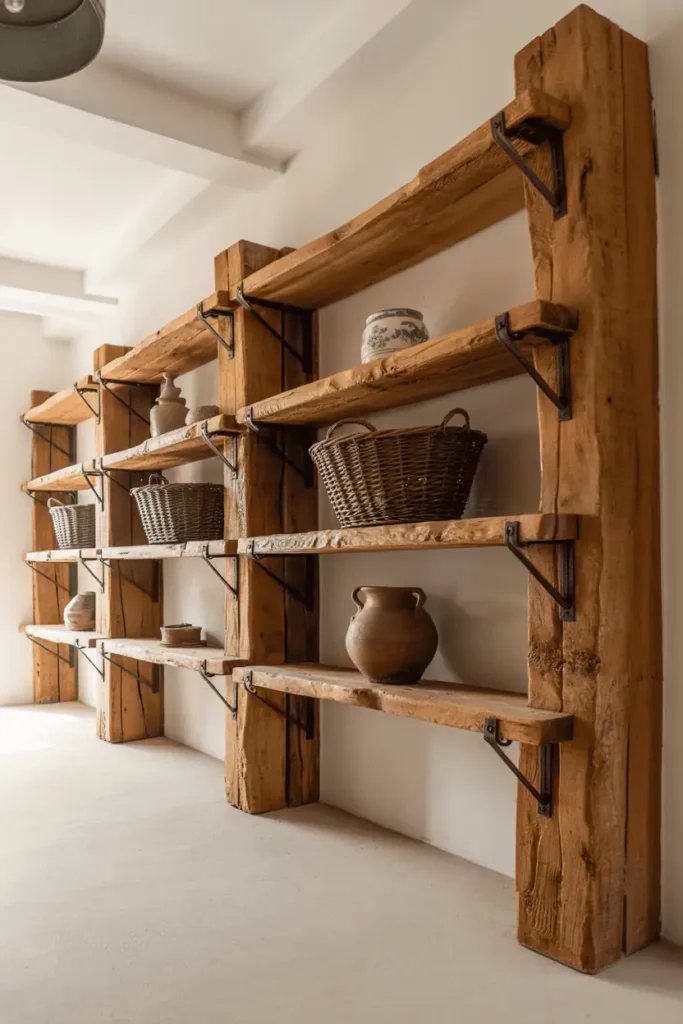
A hallway with high ceilings in a country home. Four thick, rough-hewn wood beams—possibly reclaimed—are mounted as shelves using heavy iron brackets. The beams are left unfinished, showing natural texture and age. They’re spaced widely, holding large baskets, pottery, and a few oversized books. The walls are white plaster.
The beam shelving feels substantial and grounded. The iron brackets add industrial edge. This works best in homes with rustic or farmhouse aesthetics where heavy materials feel appropriate rather than out of place.
10. Minimalist Ledge Shelves in Pale Maple
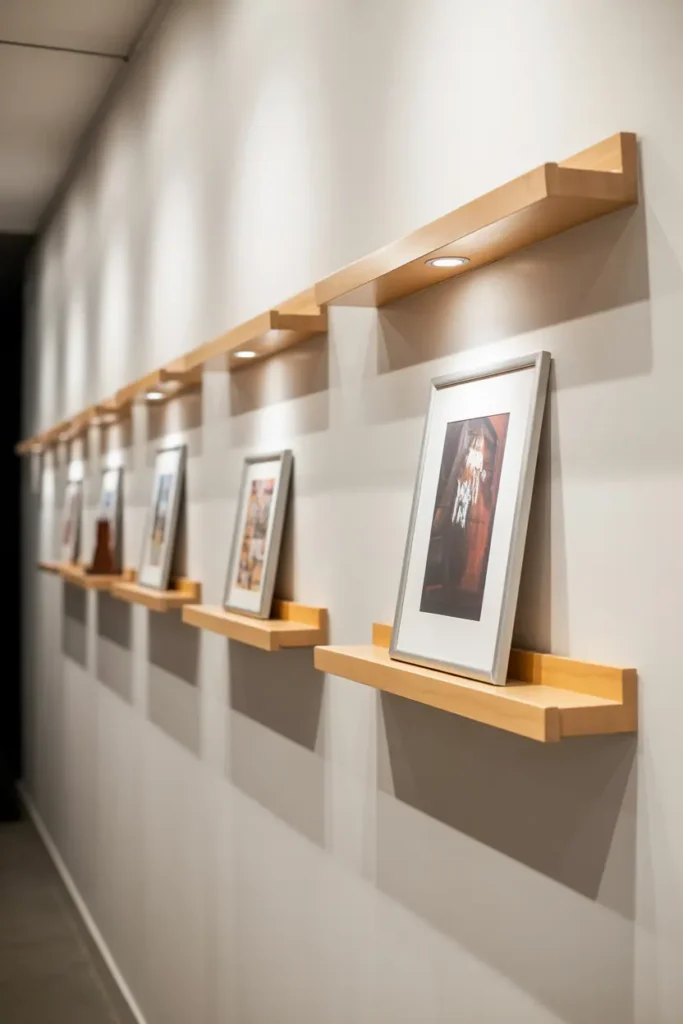
A modern hallway with clean lines. Five identical ledge shelves in pale maple run horizontally along one wall—shallow lips at the front to hold items. The shelves display a rotation of art prints leaned against the wall, with a few small objects. The walls are soft white, and recessed lighting highlights each shelf.
Ledge shelves allow for easy rotation of what’s displayed. The pale maple keeps everything light. This suits minimalist homes where flexibility and simplicity are priorities.
The shift now is toward integration. These hallways use shelving not just for storage but to establish the home’s aesthetic from the entry point.
11. Full-Wall Hallway Library in Cherry
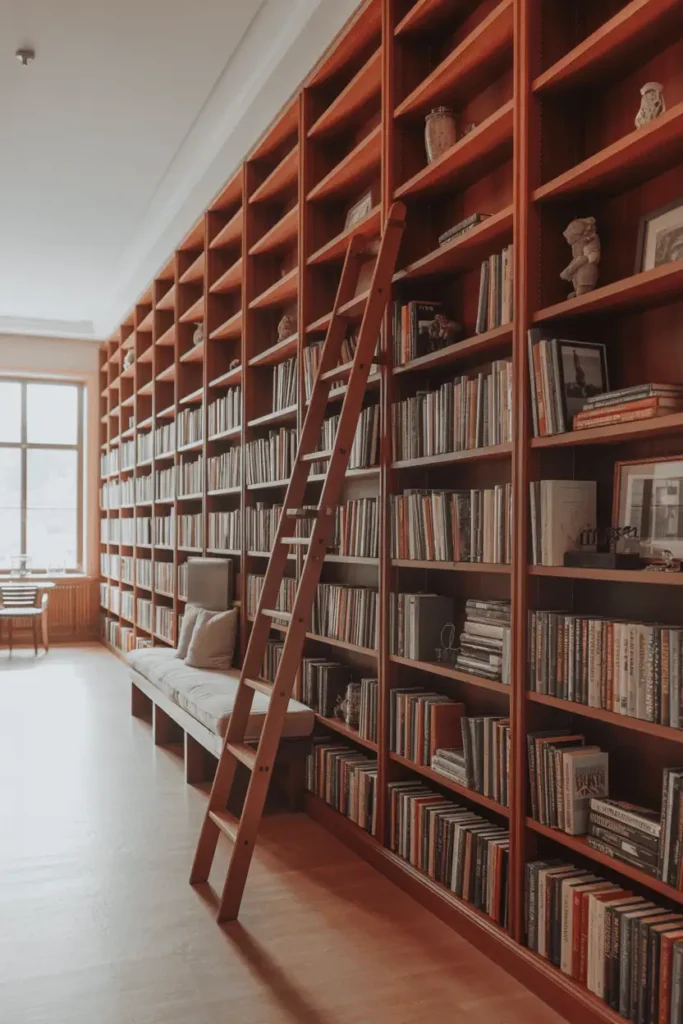
An exceptionally wide hallway—almost room-like in proportion. One full wall is covered in built-in shelving from cherry wood—floor to ceiling, with a rolling ladder for upper shelves. The shelving holds an extensive book collection mixed with decorative objects. A bench with cushions sits at the base. The opposite wall has large windows. The floor is hardwood.
This is for book lovers with space to commit. The cherry wood creates a formal, library-like atmosphere. The hallway becomes a destination rather than a transition. This works in larger homes where the hallway can serve as a secondary living space.
12. Asymmetric Modular Shelving in Birch
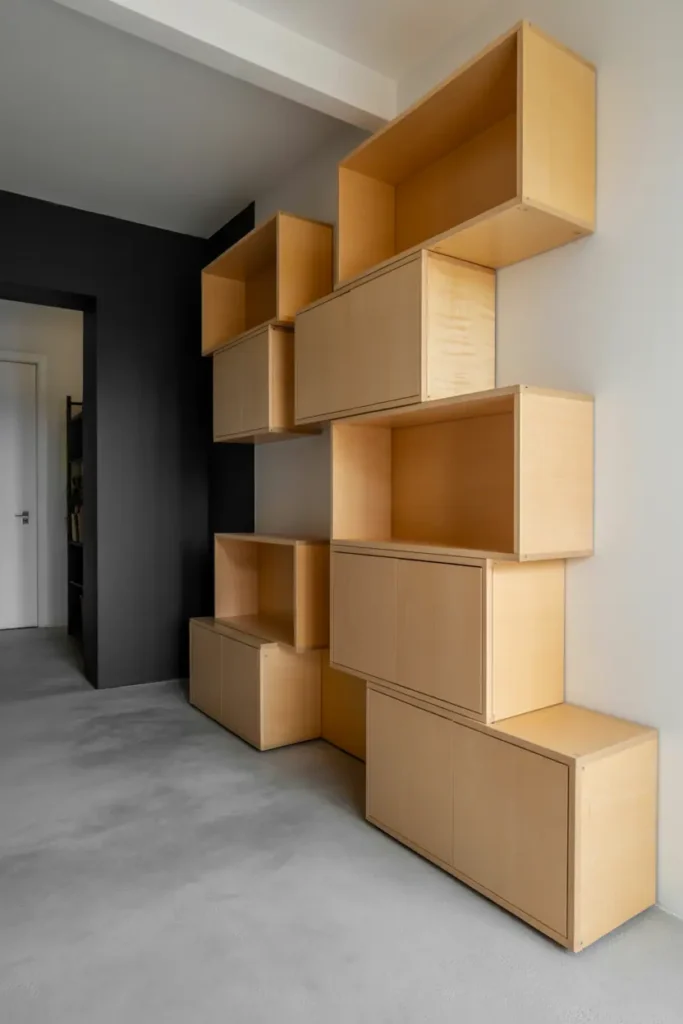
A contemporary hallway. Asymmetric modular shelving units in birch are arranged on one wall—different sized boxes stacked in a seemingly random but balanced configuration. Some boxes are open shelving, others have doors. The birch is left natural. The floor is polished concrete, and the opposite wall is painted charcoal.
The asymmetry creates visual interest in a modern way. The modular approach allows for customization. This works in contemporary homes where clean lines and functional design are valued.
13. Shallow Niche Shelving Built Into Wall
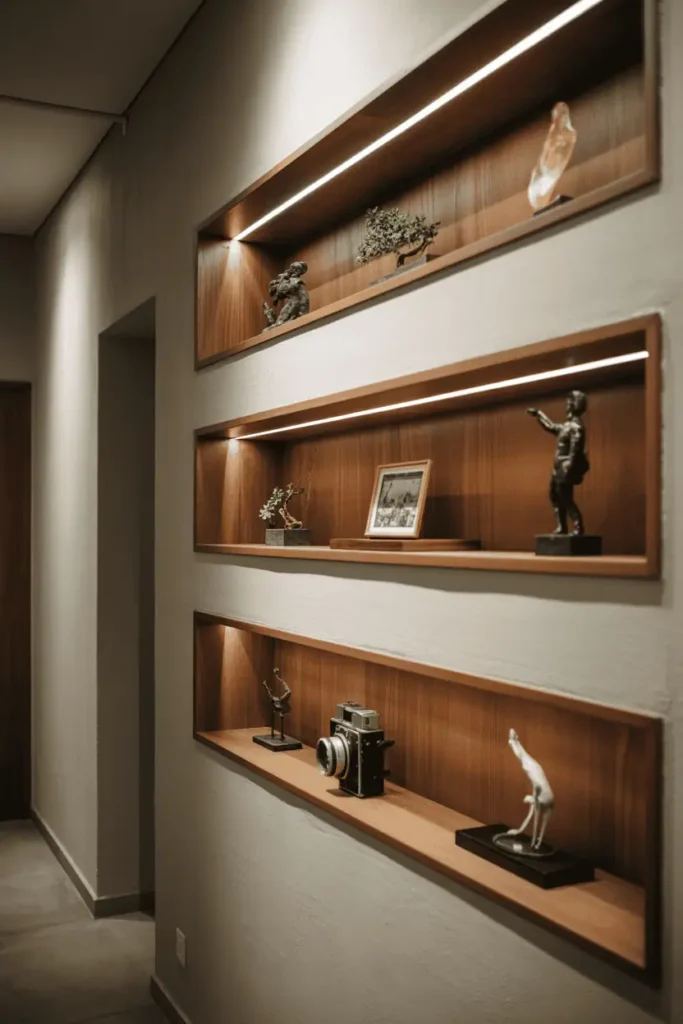
The hallway wall is thick enough to accommodate shallow niche shelving—three rectangular cutouts lined with oak, each about 4 inches deep. The niches are lit from within with LED strips. They hold small sculptures, a bonsai, a collection of vintage cameras. The wall is otherwise smooth white plaster.
Built-in niches feel architectural rather than added-on. The lighting makes them focal points. This works best in new construction or renovations where walls can be modified structurally.
14. Industrial Pipe and Wood Plank Shelving
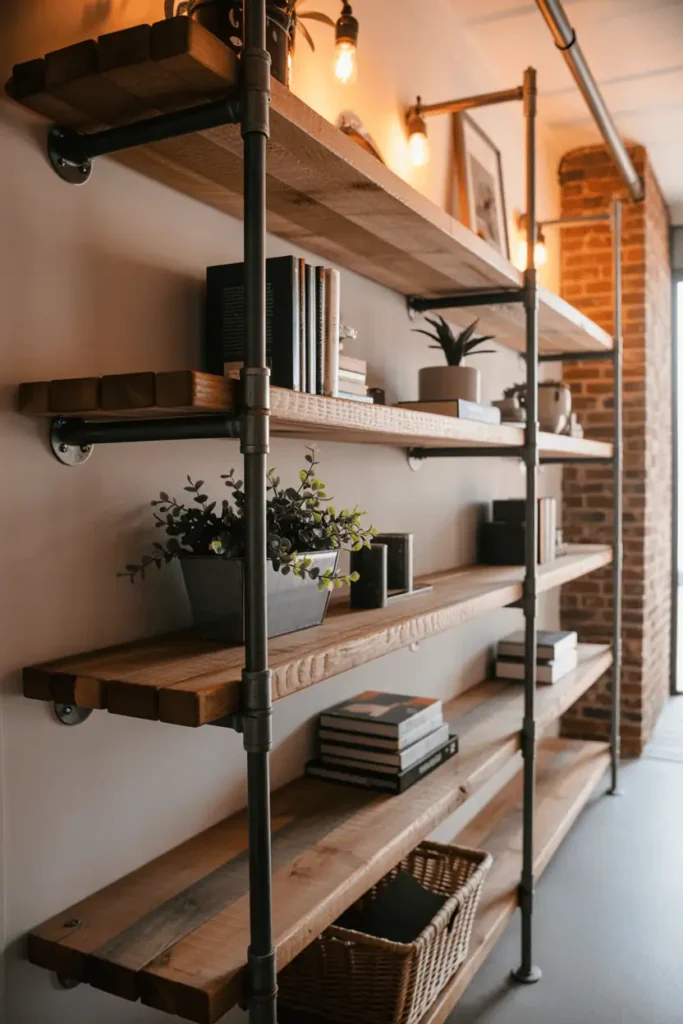
An urban loft with an industrial aesthetic. The hallway shelving consists of black iron pipes mounted as supports with thick wood planks—possibly reclaimed—laid across them. Four shelves total, with varied spacing. The shelves hold plants, books, and baskets. The walls are exposed brick, and Edison bulb fixtures provide lighting.
The pipe-and-plank approach feels DIY-friendly and adaptable. The materials are honest and unfussy. This works in lofts, basements converted to living space, or homes where industrial style already exists.
15. Narrow Hallway with Staggered Box Shelves
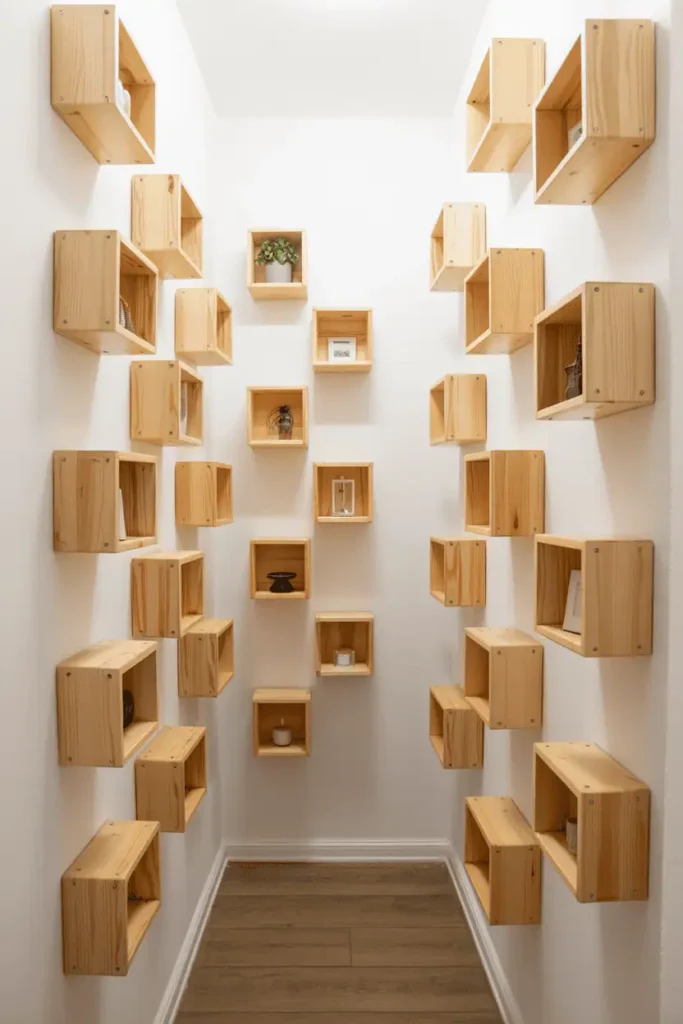
A very narrow hallway—too narrow for traditional shelving. Staggered box shelves in natural pine are mounted to alternate walls, creating a zigzag pattern as you walk through. Each box is small—maybe 10 inches square—and holds a single item: a plant, a candle, a small piece of art. The walls are white, and the floor is light wood.
The staggered approach creates rhythm in a tight space without adding bulk. It turns limitation into design feature. This works in the narrowest hallways where conventional shelving would obstruct movement.
Styling Tips to Pull the Look Together
- Match wood tone to existing flooring or trim for cohesion
- Leave some shelves partially empty—negative space matters
- Group objects in odd numbers for visual balance
- Repeat materials across the hallway (wood, ceramic, plants)
- Use lighting to highlight shelving, not just illuminate passage
- Keep functional items accessible at lower levels
- Style with intention, not accumulation
Conclusion
Hallways don’t require complete overhauls. Most of these concepts work by introducing wood shelving that suits the space’s proportions and the household’s needs. The shelving becomes both functional and atmospheric.
Start with one approach—a single floating shelf, a corner unit, a narrow bookcase—and see how it changes how you move through and perceive the space. These installations work best when they evolve gradually rather than appearing all at once.
Save the ideas that align with your hallway’s width, light, and purpose. Come back when you’re ready to refine or add. That’s how hallways shift from overlooked to intentional.

To bring you cozy inspiration more efficiently, we sometimes use AI to assist in content creation — but every word and idea is carefully shaped by our team. See our AI Disclosure for more info.